
40+ Post-processing treatments in just a few clicks.

CNC parts and post-processing treatments conveniently from a single source. Directly in our instant quoting tool.

Especially when components are subject to increased or diverse requirements, material-specific properties alone are often no longer sufficient. For example, anyone looking to combine the low density of aluminium components with improved resistance to media or abrasion will not achieve this through alloy selection alone. This is where post-processing treatments demonstrate their strength. Heat treatments, coatings, and surface modifications make it possible to tailor the property spectrum of many metallic alloys precisely to the application.

Until now, such operations either required a lengthy search for suitable subcontractors with specialised post-processing networks, or companies had to manage the second manufacturing step themselves. Particularly in product development, this can lead to unclear costs. That is why InstaWerk now offers many standard post-processing options for turned and milled parts transparently and online at any time.

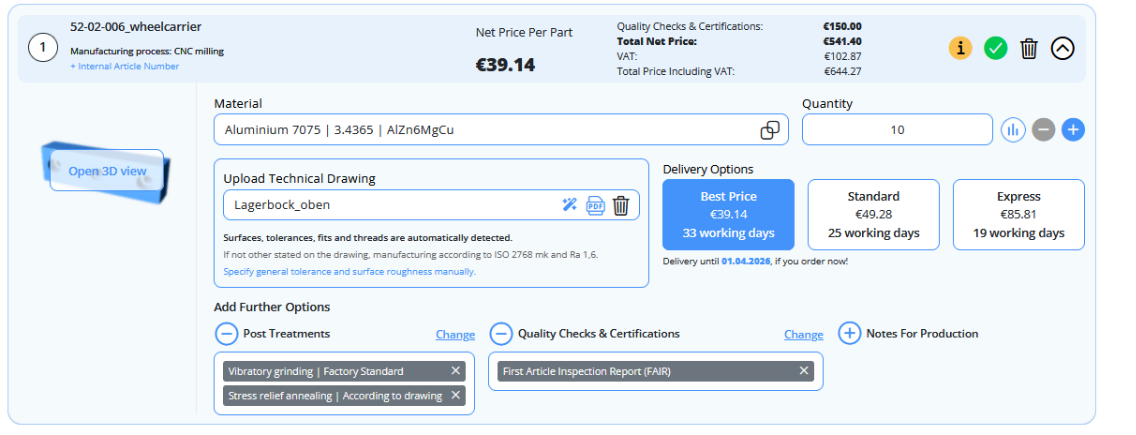
Simply upload your component, select the material, and choose the desired post-processing treatment. The price is calculated instantly, and the delivery time is adjusted accordingly.

Since many post-processing treatments require detailed clarification, for example regarding layer thickness in anodising or colour in powder coating, our technical customer support will contact you after the enquiry to clarify any open questions. This allows us to respond to your questions more effectively and take your specific requirements into account.

Applying post processing for your CNC machined parts has never been easier:

1.

Upload your parts and get an instant quote
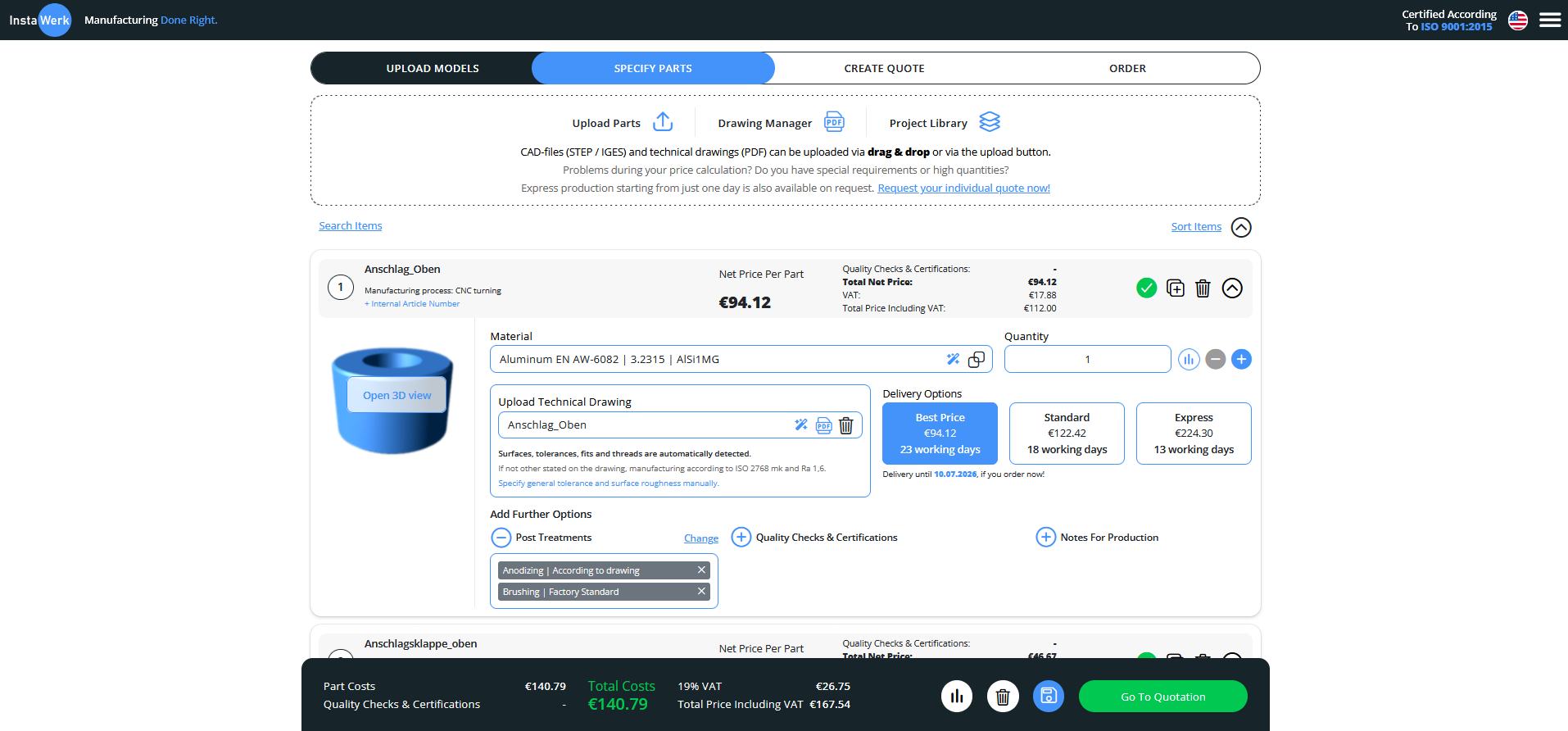
Online-configuration of cnc machined parts with all post processing steps

2.

Simply add all required post processes
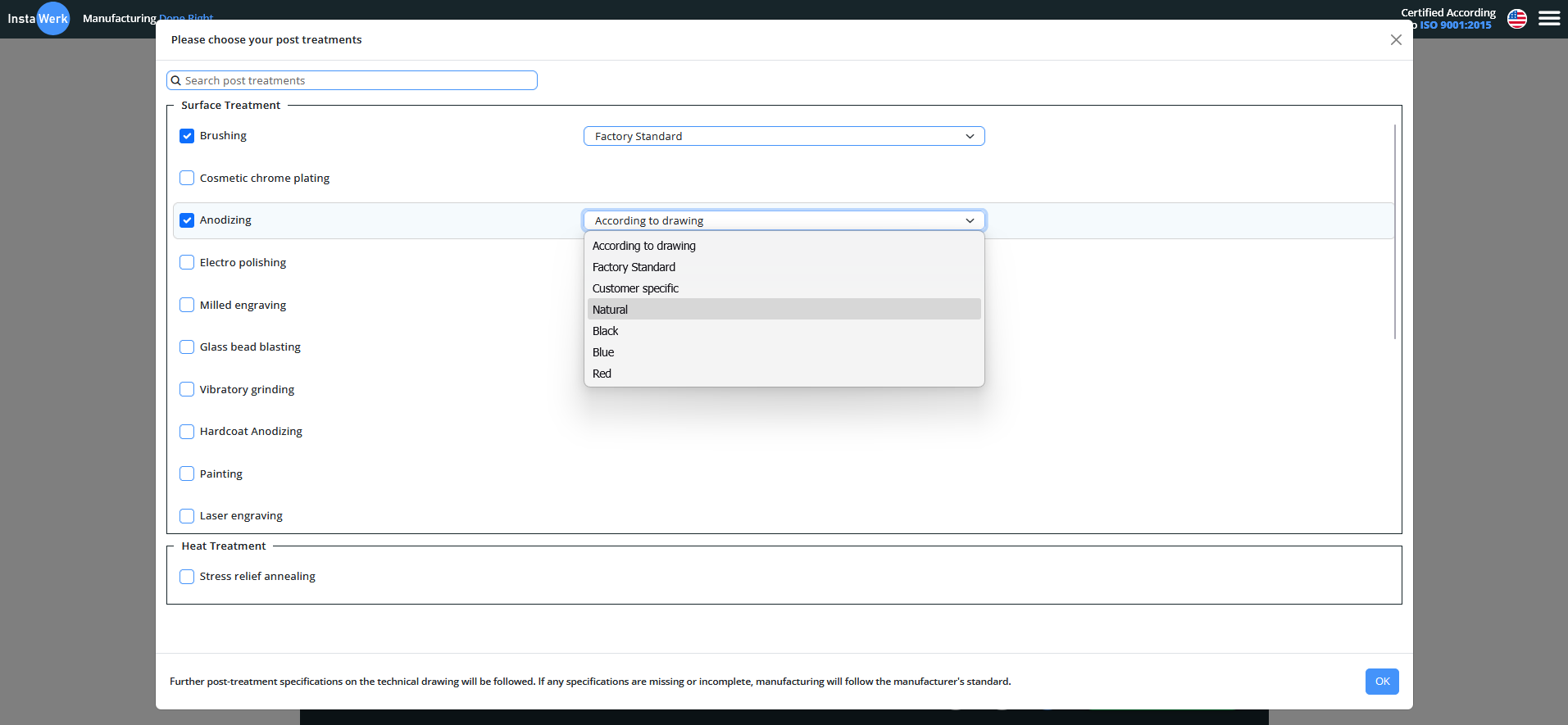
Post processes for cnc milled and turned parts

Heat
treatments

Heat treatments are used to adapt the material properties of CNC-milled and turned parts to the requirements of their final application. They can improve strength, hardness, dimensional stability, wear resistance, and long-term performance under mechanical or thermal load – all available at one click with instant quotes.

  • Tempering
  • Hardening
  • Stress-relief annealing
  • Gas nitriding
  • Plasma nitriding
  • QPQ / Quench-Polish-Quench, e.g. Tenifer
  • Carburising
  • Kolsterising

Surface
treatments

Surface treatments improve the durability, corrosion resistance, wear behaviour, and appearance of CNC-milled and turned parts. At InstaWerk, surface processing options are available directly as an instant quote in the online calculator.

  • Black oxide coating
  • Sand and glass bead blasting
  • Anodising
  • Chromating
  • Vibratory finishing
  • Electropolishing
  • Phosphating
  • Oxidising
  • Hard anodising
  • Plastic polishing
  • Trivalent chrome passivation, e.g. SurTec 650
  • Brushing
  • Passivation

Coatings
 

Coatings add a functional protective layer to CNC-milled and turned parts, improving resistance to corrosion, wear, chemicals, or visual ageing. At InstaWerk, coating options are available directly as an instant quote.

  • Chrome plating
  • Hard chrome plating
  • Zinc plating
  • Nickel plating
  • Powder coating
  • Tin plating
  • Painting

Markings, inscriptions, and more.

Marking, cleaning, and packaging options help prepare CNC-milled and turned parts for identification, assembly, handling, and delivery. At InstaWerk, these additional services are available directly as an instant quote in the online calculator.

  • Laser engraving
  • Ultrasonic cleaning
  • Milled engraving
  • Individual packaging

Our Heat Treatments for CNC-machined parts

Hardening

Which materials can be hardened? Suitable for use with various steels and cast iron alloys with a carbon content of 0.2% or higher.

  • Hardening is generally achieved by heating the component, holding it at temperature, and then rapidly quenching it. The microstructural changes caused by the heat input are “frozen” during rapid cooling, resulting in increased surface hardness.
  • Increased wear resistance of the components
  • Increased edge hardness

Stress-relief Annealing

When is stress-relief annealing applicable? It can be used on almost all metallic materials; aluminum alloys, steels, and stainless steels.

  • Stress-relief annealing reduces residual stresses in the component by increasing the temperature. The slow heating and even slower cooling process allows these residual stresses to relax without distortion.
  • Low-distortion machining, as no residual stresses are released.
  • Reduction of the residual stresses acting in the component during use

Gas Nitriding

Which materials can be gas nitrided? Applications include tempered nitriding steels, structural steels, and heat-treatable steels.

  • In gas riveting, a thermochemical process, atomic nitrogen diffuses from gaseous ammonia (NH3) into the steel. This creates a wear-resistant and corrosion-resistant surface layer of approximately 0.2–1.0 mm.
  • Fast-track procedure
  • Increased fatigue strength
  • Improved corrosion protection

Plasma Nitration

Which materials are suitable for plasma nitriding? Applications include tempered nitriding steels, structural steels, and heat-treatable steels.

  • Nitrogen also diffuses into the steel during plasma nitriding. However, the atomic nitrogen is generated in an (ionized) plasma environment, resulting in a high degree of uniformity of the nitride, albeit at a higher cost.
  • Very low distortion of the components
  • Excellent corrosion protection

QPQ / Quench-Polish-Quench, e.g. B. Tenifer

Which materials are suitable for QPC? Suitable steels, especially low- and medium-alloy steels.

  • QPQ is a multi-stage thermochemical process in which the surface is treated by nitriding, polishing, and subsequent post-oxidation. This creates a hard, wear-resistant surface layer with additional corrosion protection.
  • Increased wear resistance and surface hardness
  • Improved corrosion protection compared to untreated steel

Carburetors

Which materials are suitable for carbuning? Case-hardening steels and suitable low-alloy steels with low carbon content.

  • During carburizing, carbon is introduced into the surface layer of the component. The component can then be hardened, resulting in a hard, wear-resistant surface with a tough core.
  • High edge hardness in load-bearing components
  • Good combination of wear protection and core toughness

Starting

Which materials are suitable for tempering? Hardened steels and suitable steel alloys.

  • Tempering takes place after hardening and serves to reduce internal stresses and to precisely adjust the mechanical properties. Depending on the temperature, the hardness, toughness, and brittleness of the component can be influenced.
  • Reduction of brittleness after hardening
  • Setting a balanced ratio of hardness and toughness

Kolsterize

Which materials are suitable for Kolsterizing? Austenitic stainless steels and selected corrosion-resistant alloys.

  • Kolsterizing is a thermochemical process for hardening the surface layer without significantly impairing the corrosion resistance of the stainless steel. Carbon is introduced into the surface, creating a hard, wear-resistant surface layer.
  • Significantly increased surface hardness in stainless steel
  • Improved wear resistance while maintaining corrosion resistance

Nitrate

Which materials are suitable for nitriding?  Suitable steels, in particular nitridable heat-treatable, tool and case-hardening steels.

  • In nitriding, nitrogen is introduced into the surface layer of the component. This creates a hard and wear-resistant surface without requiring the component to be fully hardened. The process is particularly suitable for highly stressed functional surfaces.
  • Increased edge hardness and wear resistance
  • Minimal distortion compared to conventional hardening processes

Our Surface Treatments for CNC-milled and turned parts

Bluing

Which materials can be blued? Blueing can be used on all oxidizable materials (e.g., steel, stainless steel, iron, brass, bronze).

  • Bluing creates a “noble rust” – a desired metal oxide compound – by immersing the workpiece in an alkaline or acidic solution on ferrous surfaces, thus providing corrosion protection. Since no other substance is applied to the component, this is not considered a coating. The surface is black after treatment.
  • Improved corrosion protection
  • Good optical properties (deep black)
  • Reduction of reflection
  • High dimensional stability due to low temperature input

Sandblasting and Glass bead blasting

Where can it be used? Basically applicable to all materials, but particularly advantageous for metal components.

  • In sandblasting and glass bead blasting, abrasive particles are directed at the metal part using compressed air. This removes material from the surface, typically resulting in a matte finish. Blasting can be used, for example, to deburr components. Glass bead blasting produces a less pronounced surface roughening compared to sandblasting.
  • Increased surface layer strength through surface compaction
  • Almost no burrs, but therefore also less pronounced corners
  • Also particularly suitable for components to be bonded, provided they are properly prepared, as the adhesive forms a micro-interlocking connection.

Anodizing

Which materials can be anodized? Anodizing can only be used on aluminum alloys.

  • Anodizing is a process in which aluminum components are electroplated to create a protective oxide layer. The thickness of this layer can be adjusted by varying the electrolyte and the process parameters. An important parameter in this process is the layer thickness.
  • Improved corrosion protection and minimal impact on dimensional accuracy
  • Wide selection of colors and good adjustability of layer thickness.
  • Caution: The anodized layer is non-conductive. Furthermore, the numerous aluminum alloys can only be anodized to varying degrees.

Chromating

Which materials can be chromated? Chromating can be used primarily on aluminum alloys and zinc.

  • During chromating, metal components are treated in chromic acid. This process forms chromates on the surface, which are inorganic compounds of chromium and metal ions from the substrate. When using chromium(IV)-free solutions, the process is called “passivation”.
  • Improved corrosion protection up to approx. 80°C
  • Well suited for preparing paintwork as a primer.
  • Caution: Due to legal regulations (EU End-of-Life Vehicle Regulation, RoHS Directive), chromatings containing carcinogenic Cr (VI) compounds have been prohibited from use in the automotive industry and many other sectors since July 1, 2007.

Vibratory finishing

Which materials can be vibratory finished? Almost all materials.

  • In vibratory finishing, the components are placed in a rotating container along with abrasive media. The relative movement between the components and the abrasive media softens edges, rounds edges, and smooths the component.
  • Deburring sharp edges
  • Matte surfaces

Electropolishing

Which materials can be electropolished? Conductive materials, preferably stainless steels, brass, copper, titanium alloys.

  • In electropolishing, the workpieces to be polished are connected as the anode in an electrochemical cell. The removal of burrs and irregularities results in shiny, polished surfaces.
  • Glossy surface with minimal material removal from the workpiece, therefore also very good dimensional accuracy.
  • Low surface roughness and therefore reduced coefficients of friction.
  • Further improved corrosion resistance in stainless steels
  • No mechanical or thermal stress on the component to be polished.

Phosphating

Phosphating can be used on steel, ferrous materials, zinc and aluminum.

  • In phosphating, metal components chemically form a so-called “conversion layer” through the action of phosphate solutions. This action is carried out by spray application or immersion.
  • Improved corrosion protection, reduced wear and friction coefficients
  • Due to its microporous or microcapillary surface, it can be used as a base for painting.
  • Caution: High electrical resistance due to phosphating of the surface

Oxidizing / Steam tempering

Oxidizable materials : Oxidization is used on metal parts made of steel.

  • Oxidization (also known as steam tempering or, colloquially, “blackening of steel”) is generally used in combination with nitriding processes. In this process, the component is exposed to steam, which oxidizes the iron content and creates a corrosion-resistant layer.
  • Improved sliding properties due to reduced coefficient of friction and high surface layer hardness
  • Surfaces that have been oxidized look similar to burnished surfaces (anthracite-black in color), but are more corrosion-resistant.
  • Sed aliquam metus

Hard Anodizing

Materials : Aluminium and suitable aluminium alloys.

  • Hard anodizing is an electrochemical treatment that creates a particularly hard and wear-resistant oxide layer on the aluminum surface. Compared to conventional anodizing, this results in a thicker, more robust protective layer with high resistance to abrasion and corrosion.
  • Increased wear resistance of the components
  • Improved corrosion protection for aluminum parts

Plastic Polish

Materials : Suitable plastics, especially transparent or optically relevant plastic components.

  • Plastic polish is used to smooth and visually enhance plastic surfaces. It reduces fine machining marks, matte areas, and minor surface irregularities to achieve a clearer and higher-quality finish.
  • Improved optical quality of the plastic surface
  • Reduction of fine scratches and machining marks

Tri-chrome passivation, e.g. Surtech 650

Materials : Aluminium and suitable aluminium alloys.

  • Tri-chrome passivation is a chromium(VI)-free surface treatment for aluminum. It creates a thin conversion layer that improves corrosion protection while largely maintaining the electrical conductivity of the surface.
  • Improved corrosion protection for aluminum components
  • Chromium(VI)-free alternative to classic chromating

Brush

Materials : Metals such as stainless steel, aluminum, steel and brass.

  • Brushing involves mechanically treating the surface with grinding or brushing tools. This creates a uniform, directional surface structure that reduces machining marks and gives the component a high-quality, technical appearance.
  • Uniform, directional surface structure
  • Visual enhancement of visible and design components

Passivation

Materials : Stainless steel, aluminum and other suitable corrosion-resistant materials.

  • Passivation involves chemically treating the surface to improve or selectively build up the material’s natural protective layer. Particularly with stainless steel, this treatment promotes the formation of a stable, corrosion-resistant passive layer.
  • Improved corrosion protection
  • Removal of free iron particles and activation of the protective layer

Our available Coatings for instant quotes

Chrome Plating

Chrome plating can be used on steels, aluminium, non-ferrous metals and their alloys, as well as plastic components.

  • Chrome plating is produced using electroplating techniques. In this process, the chromium is deposited from a chromium salt base.
  • Glossy and matte finishes available
  • It is mainly used for decorative applications; for technical applications, hard chrome plating (see right) is preferred.
  • Chrome plating smooths the surface, thereby improving the sliding properties and increasing chemical and corrosion resistance.

Hard chrome Plating

Hard chrome plating can be used on all steels, aluminium, non-ferrous metals and their alloys.

  • Hard chrome plating is produced using electroplating techniques. In this process, the chromium is deposited from a chromium salt base.
  • Primarily used as protection against wear and to reduce adhesion, therefore also an increased layer thickness of up to several millimeters compared to optical bright chrome plating.
  • Good cleanability of the components

Zinc Plating

Zinc plating can be used on low-alloy steels, spring steels, hardened steels, and non-ferrous metals.

  • Zinc plating is produced by electroplating zinc in acidic or alkaline electrolytes.
  • Zinc plating provides a double corrosion protection effect, as both a zinc coating protects the component from corrosion, and zinc also acts as a sacrificial cathode against the more noble iron.
  • Protection against corrosion, attack by lubricants and solvents, thermally resistant

Nickel Plating

Nickel plating can be used on steel, stainless steel, aluminum, and non-ferrous metals.

  • The nickel coating is produced electrolytically from nickel-containing aqueous solutions, so-called nickel electrolytes, during the nickel plating of metal components.
  • Resistance to acids and bases (but not to, for example, nitric acid, concentrated hydrochloric acid, or ammonia)
  • High corrosion resistance
  • Electrically conductive coating

Powder Coating

Powder coating can be used for metallic materials such as steel, stainless steel and aluminum.

  • Powder coating involves applying an electrostatically charged coating powder to the component surface and then baking it in an oven. This creates a uniform, durable, and decorative protective layer.
  • Decorative surface available in many colors
  • Protection against corrosion, scratches and environmental influences

Tinning

Copper, brass, steel and other suitable metallic materials can be tinned.

  • Tinning involves applying a thin layer of tin to the component surface. This layer improves solderability, protects against corrosion, and can enhance the electrical contact between components.
  • Improved solderability and electrical contactability
  • Corrosion protection through a metallic protective layer

Painting

Metals and plastics, depending on the material, pretreatment and application.

  • Painting involves applying a liquid coating to the component’s surface, which is then dried or cured. Paints can fulfill functional protective purposes while simultaneously defining the component’s color, gloss level, and appearance.
  • Individual color and surface design
  • Protection against corrosion, moisture and environmental influences

Markings, inscriptions, and more. Online quotes.

Laser Engraving

As an alternative to milling, we offer laser engraving for component designations, serial numbers, and other information. Logos and graphics can also be applied to the component.

  • Cost-effective and flexible process
  • Since the engraving is created by discoloring the surface, the dimensional accuracy and flatness of the engraved surface are only minimally affected (compared to milling, no material is removed).

Ultrasonic Cleaning

If CNC components need to be free of grease, cutting oils, and other contaminants, ultrasonic cleaning is a suitable option. High-frequency vibrations in the cleaning bath reliably remove contaminants from the component.

  • Cost-effective
  • Suitable for almost all materials
  • No impact on the components regarding dimensional accuracy, surface finish and mechanical strength.

Milled Engraving

Metals and plastics, depending on geometry, material and desired engraving depth.

  • In milled engraving, lettering, numbers, logos, or markings are mechanically etched into the surface of a component. The engraving is permanent, easily legible, and particularly suitable for functional markings or individual labeling.
  • Permanent marking directly in the component
  • Suitable for serial numbers, logos and technical markings

Individual Packaging

Almost all CNC milled and turned parts, especially sensitive or high-quality components.

  • Individual packaging involves packing components separately to avoid contact points, scratches, or transport damage. This is particularly useful for visible parts, coated components, or sensitive surfaces.
  • Protection against scratches and damage during transport
  • Clean separation and easy assignment of individual components

Access our unlimited manufacturing ressources now:

Instant Quoting | Unlimited Manufacturing Capacity | High Quality Exclusive Network | Short delivery times