


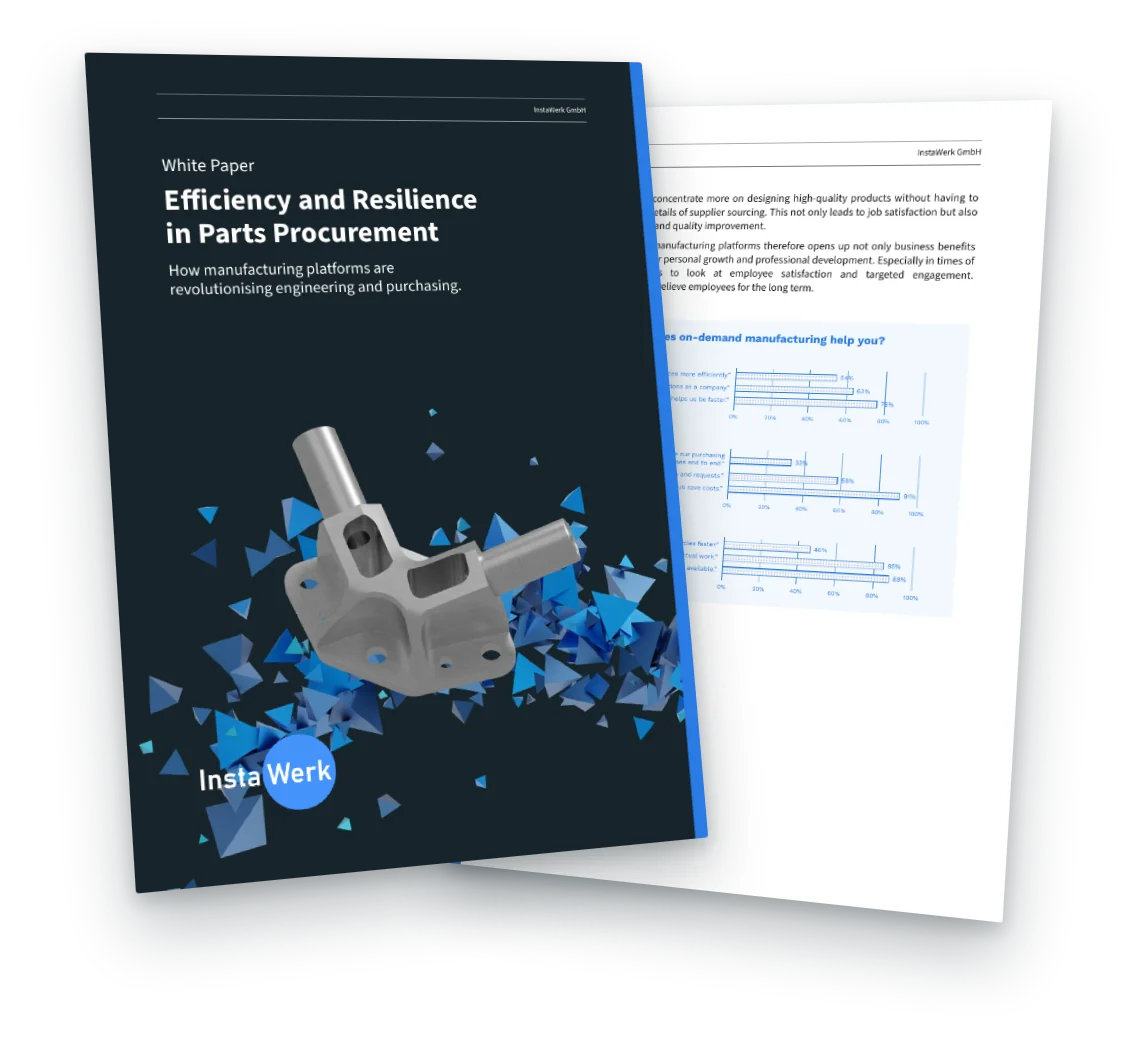
 White Paper 2026
How on-demand manufacturing platforms are changing the way engineers and buyers source CNC-machined parts – and what this means for cost, speed and supply-chain resilience.
Read the key findingsGet the white paperResults achieved by InstaWerk customers.
Parts sourcing has become a strategic lever
Industry is facing political and economic uncertainty, rising costs and a persistent skills shortage. At the same time, traditional job shops struggle with long lead times, limited capacity and gaps in cost competitiveness and digital capabilities. Delivering complex manufacturing projects on time and on budget is getting harder.
Digital manufacturing platforms offer more than machining capacity: instant online quotes, digital interfaces and ERP integration, and management of the entire procurement, quality and logistics process. Order bundling, technical specialisation and an actively managed supplier network create cost and efficiency gains – all the way to fully automated purchasing.
Users see the gains in speed, manufacturing options and supply reliability as major strategic advantages. Accordingly, 75% of companies currently use manufacturing platforms for short-term, tactical needs such as prototypes.
What this means for …
“On-demand manufacturing helps us be faster.”
Digitising low-value but time-consuming sourcing tasks frees engineering and purchasing capacity for value-adding work – improving margins and market position.
“On-demand manufacturing helps us save costs.”
Transparent, competitive pricing, framework agreements and automated ordering – with a seamless path from prototype to series production.
“We have more materials and processes available.”
Iterate faster with instant pricing across 90+ materials and 40+ heat and surface treatments, from first prototype to production readiness.
Share of respondents who agree. InstaWerk customer survey, n=627, March 2026.
Uncertainty is rising. Sourcing is still stuck in email.
In Germany alone, more than one million engineers regularly need CNC parts – and more than 8,000 job shops supply them, each with its own specialisation and fluctuating capacity. Matching the two still relies on manual requests, comparisons and follow-ups that take days or weeks, and buyers are often left unsure whether a quote is fair.
of turned and milled parts for prototypes and small batches are sourced through inefficient processes in Germany every year.
in series procurement – the same inefficiency at much larger scale.
Which challenges is your company facing?
InstaWerk customer surveys (n=480, September 2023 · n=627, March 2026).
of executives experienced severe or very severe supply-chain impacts from at least one disruption in the last 12–18 months.
agree that the frequency of these disruptions has increased over the last ten years.
say these disruptions have hurt their productivity and profits.
Source: Deloitte, Supply Chain Pulse Check, 2023.
Why companies turn to manufacturing platforms
On-demand platforms give engineers and buyers instant access to a curated network of manufacturers through digital interfaces. By bundling orders, they give small and mid-sized companies the purchasing power of large corporations – and multi-sourcing makes supply chains more resilient against outages and political uncertainty.
of engineers under 40 in the US order their parts from on-demand or online manufacturing platforms – a trend now emerging in Germany too.
Why do you use manufacturing platforms?
InstaWerk customer surveys (n=480, September 2023 · n=627, March 2026). Multiple answers possible.
Reverse auction or direct allocation?
From the outside, manufacturing platforms look alike. The real difference is how they place orders with manufacturers – and that decides quality, reliability and data security.
Reverse auction
- Each order goes to the lowest bidder, one by one
- Small, unattractive order volumes for manufacturers
- Fluctuating part quality and on-time delivery
- Drawings are shared with many bidders
- Short-term, transactional relationships
Direct allocation with a target price
- Orders are checked and bundled into relevant volumes
- Placed directly with a pre-audited, specialised manufacturer
- Closed network bound by NDAs – your data stays with one partner
- Long-term partnerships: better quality earns more orders
- All parts pass through our in-house quality and logistics centre
AI supports. Experts decide.
At InstaWerk, AI is not an autonomous decision-maker but a supporting system – our experts make the final call. This keeps the models learning while minimising errors caused by data artefacts.
Drawing recognition
Computer vision reads materials, fits, tolerances, surface specifications and geometric tolerances from technical drawings – trained on more than 1 million labelled drawings and cross-checked against the 3D model.
Instant costing
Geometry analysis, machine assignment and data from parts already produced deliver a reliable price in seconds – instead of waiting days or weeks for a quote.
Allocation and quality analytics
Orders are bundled by machine type and allocated to the best-fitting partner. Continuous supplier scoring rewards strong performers with more orders.
Explore the chapters
Manufacturing challenges 2026
What has changed for manufacturers and buyers since 2023 – and what has not.
Read chapter →Chapter 2What manufacturing platforms are
How on-demand platforms work and why companies use them.
Read chapter →Chapter 3The strategic case
Benefits for management, purchasing and engineering.
Read chapter →Chapter 4Reverse auction vs. direct allocation
Why the allocation model decides quality and data security.
Read chapter →Chapter 5AI in CNC sourcing
Drawing recognition, instant costing and smart allocation.
Read chapter →Chapter 6Key figures 2026
All survey results and market figures at a glance.
Read chapter →“Turned and milled parts stand for precision and enable high-quality products. But they are often cost drivers – and supply bottlenecks turn them into a bottleneck in time. Our mission is to give our customers an end-to-end sourcing solution for turned and milled parts: cost-efficient, scalable and quality-driven.”
Marcel Erich
Managing Director, InstaWerk GmbH
Frequently asked questions
What is a digital manufacturing platform?
A digital manufacturing platform connects companies that need custom parts with a network of qualified manufacturers through software. It captures and checks technical requests, calculates prices instantly from CAD data and manages production, quality and logistics – so buyers get reliable quotes and parts without searching for suppliers.
How much can companies save with a manufacturing platform?
InstaWerk customers reduce part costs by 19% on average and procurement overhead by up to 90%, because quoting, supplier selection, ordering, quality assurance and logistics run through a single digital interface.
What is the difference between a reverse auction and direct allocation?
In a reverse auction, manufacturers underbid each other for individual orders. That often leads to unattractive volumes, fluctuating quality and wide distribution of your drawings. With direct allocation, the platform bundles orders and places them with a selected, specialised manufacturer at a target price – creating long-term partnerships, stable quality and better data protection.
How does AI-based drawing recognition work?
Computer vision identifies features in technical drawings – materials, fits, tolerances, post-treatments, surface specifications and geometric tolerances. InstaWerk trained its model on more than 1 million labelled drawings; it also uses information from the 3D model for context-based interpretation.
Can a manufacturing platform be connected to our ERP system?
Yes. In addition to the web interface, InstaWerk offers an OCI interface, so parts can be ordered directly from ERP systems such as SAP – without re-keying data or media breaks.
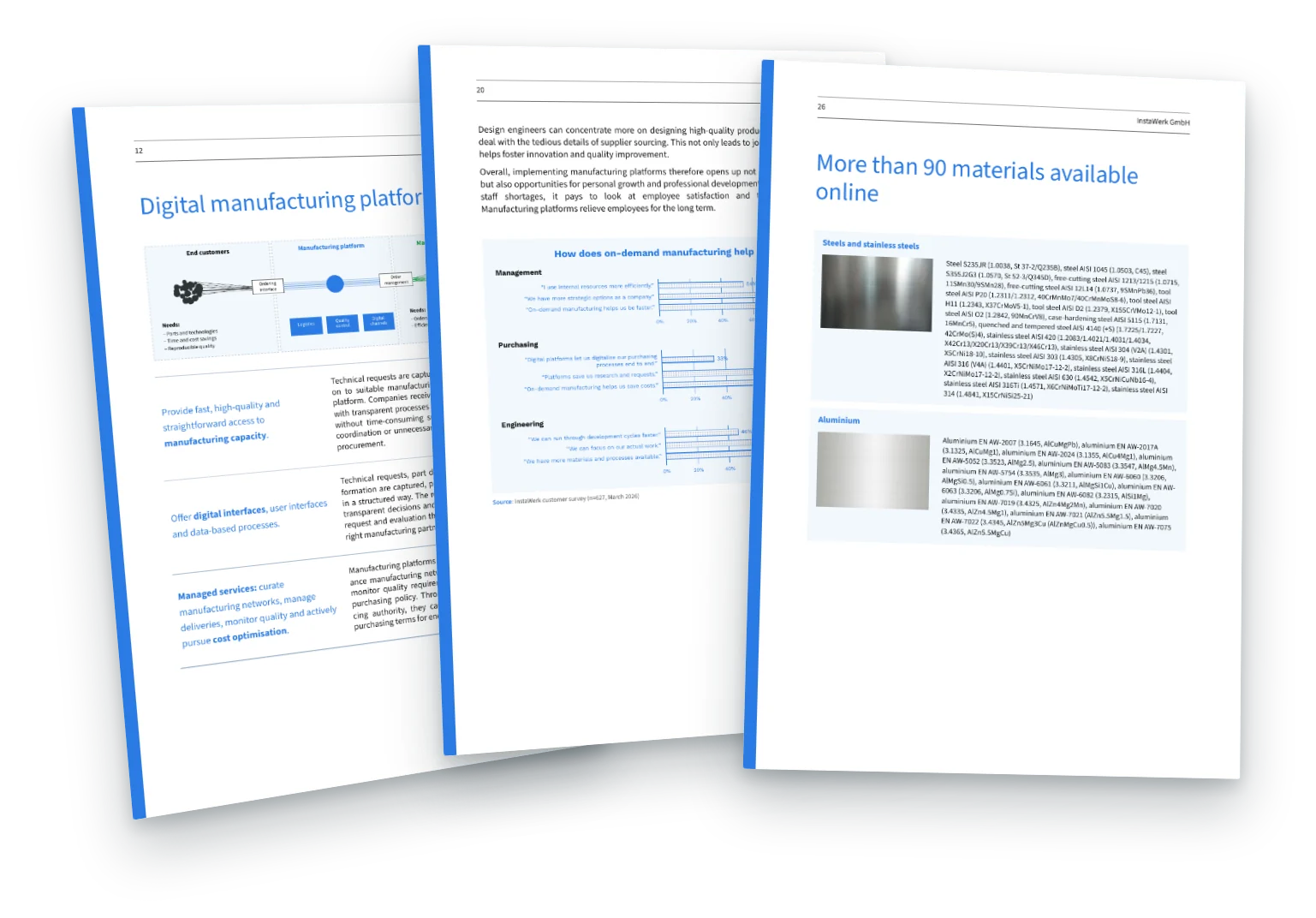
Get the full white paper
The complete English edition with all survey results, charts and the InstaWerk perspective on the future of parts sourcing.
Free · English edition · 40 pages
Want to see it in action right away?
Get an instant quoteTalk to an expert